A pilot European case for justice: Mariupol Justice presented in Strasbourg
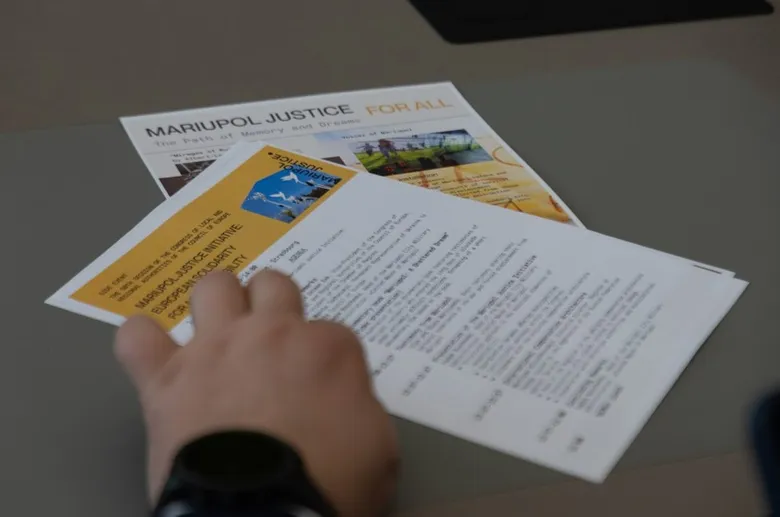
In Strasbourg, during the 50th session of the Congress of Local and Regional Authorities of the Council of Europe, the Mariupol Justice initiative was presented as a pilot case shaping the approach to holding Russia accountable for war crimes and restoring justice for affected communities.
During a working visit to Strasbourg at the invitation of the Congress of Local and Regional Authorities of the Council of Europe, Mayor of Mariupol and Head of the Mariupol City Military Administration Vadym Boichenko took part in the Congress proceedings, spoke in the debates, and held a series of bilateral meetings with representatives of European institutions.
Speaking during the debate on decentralization and territorial governance, he emphasized the role of communities and people in strengthening the country’s resilience, as well as the need for a systematic approach to restoring justice.
“Today, communities from the occupied Donetsk region share a clear demand justice and accountability for Russia’s crimes against our cities. People are asking for a stable life in Ukraine, for security, for justice. It is around justice for Ukraine that we are building a coalition of international partners. I want the Congress of the Council of Europe to become the place where a coalition for justice for Ukraine is formed a coalition capable of holding Russia accountable for all crimes committed against the Ukrainian people,” said Vadym Boichenko, Mayor of Mariupol and Head of the Mariupol City Military Administration.
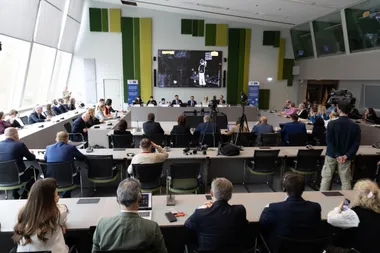
A key highlight of the session was the special event “The European Municipal Dimension of Accountability: The Mariupol Justice Initiative,” which brought together over 60 participants, including representatives of European institutions, international organizations, and the diplomatic community.
For the first time, restoring justice for Mariupol was presented as a standalone case requiring legal assessment and decisions at the international level. At the center of the discussion was the global human rights initiative Mariupol Justice, which brings together core tools: crime documentation, eyewitness testimonies, damage analysis, and international advocacy.
To date, at least 12,500 reports of killed Mariupol residents have been verified. Around 90% of the city’s infrastructure has been damaged, and 40% of its housing stock destroyed. Preliminary estimates put total losses at over $14 billion, though the true scale of the tragedy may be significantly higher.
Council of Europe Commissioner for Human Rights Michael O’Flaherty stressed the fundamental importance of accountability:
“We cannot achieve lasting peace without accountability, and we must not sacrifice justice for the sake of a superficial peace. That is why a tribunal for the crime of aggression is so important, and I will continue to fully support it. At the same time, we must ensure that people in temporarily occupied territories are not forgotten in discussions about the future. Reconstruction must be grounded in human rights and meaningful public participation to deliver sustainable, long-term results”.
Participants also focused on building an international compensation system. In particular, they discussed the role of the International Register of Damage (RD4U), to which Mariupol residents have already submitted over 25,000 claims—the highest number among Ukrainian communities.
“Ukraine is the Congress’s top priority. Mariupol has become a stark reminder of how quickly progress can be destroyed—a city that was once rapidly developing is now devastated by war and occupation. But thanks to the resilience of its people and international support, it will rise again. A damage register is already being established as a foundation for justice, and a claims commission will soon begin its work. At the same time, significant progress has been made toward creating an international tribunal for the crime of aggression. This is a crucial step toward accountability and restoring justice. And I want to assure you: this issue remains among our highest priorities,” said Cecilie Dahlman Eek, Vice-President of the Congress of Local and Regional Authorities of the Council of Europe and President of the Chamber of Regions.
At the same time as crimes are being documented, a practical recovery track is taking shape—particularly in providing housing for those who lost their homes. In response to community needs, initial solutions are already in place: a concept for social affordable housing has been developed, design of the first projects has begun, and approaches to scaling the model with international partners have been defined.
“As for cooperation with Ukraine, it is an unconditional priority for us. When we talk about support, we mean financing. Our main focus is meeting the needs of the population, as they have been the most affected by the war. One of the key initiatives is a project aimed at building housing for internally displaced persons. €10 million has already been allocated under this programme, and it is ongoing,” said Christiane Schiemer, Head of the Secretariat of the Council of Europe Development Bank.
During the visit, Vadym Boichenko held a series of bilateral meetings with representatives of European institutions.
In a meeting with Mykola Tochytskyi, Permanent Representative of Ukraine to the Council of Europe, the parties discussed engaging international partners in the development of affordable housing projects for internally displaced persons, as well as advancing the Mariupol Justice initiative and shaping a reparations mechanism for Ukraine.
“Mariupol is not only about destruction it is also about resistance and resilience. It is a city that has endured the devastation of its infrastructure and grave human rights violations. That is why its tragedy matters. This is not just evidence it is a moral foundation for the international community and for Ukraine’s recovery. Europe is where accountability must be ensured. This is where key international mechanisms are taking shape: a damage register is being established, a comprehensive compensation mechanism is being developed, and we are moving toward the creation of a special tribunal for the crime of aggression. And we have the capacity to make this happen,” said Mykola Tochytskyi, Permanent Representative of Ukraine to the Council of Europe.
Separate meetings were also held with representatives of the European Court of Human Rights. The discussions focused on the importance of systematically documenting crimes, securing international recognition of the Mariupol tragedy, and using the collected evidence in future legal proceedings.
A key role in building the evidence base is played by the Rinat Akhmetov Foundation’s “Voices of Civilians” Museum, which has already collected over 140,000 testimonies from Ukrainians, including nearly 12,000 from Mariupol residents.
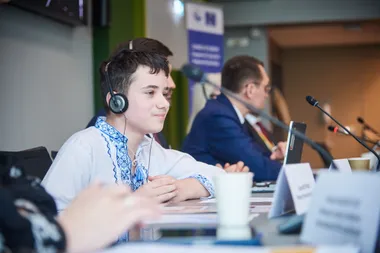
At the Council of Europe, Illia Matviienko shared his story a boy who survived injury, the loss of his mother, and forced deportation, and became one of the first children to be returned to Ukraine. He is now finally able to feel safe again with his family.
“Shelling started. A missile hit a nearby building shrapnel struck my legs, and my mother was hit in the head. She died the next day. Later that day, Russian forces came and deported me to Novoazovsk, and then to Donetsk. By sharing our stories, we make sure Europe does not forget that we exist that there is a real and serious threat in Russia and everything it is doing to Ukraine,” said Mariupol resident Illia Matviienko.
Bringing together Ukrainian communities, international institutions, and partners is creating a systemic foundation for moving from documenting crimes to legal action.
In this process, Mariupol Justice serves as a pilot case integrating data, testimonies, and international mechanisms to achieve its core goal: holding Russia accountable and securing fair compensation for victims.